
Electrical Design & Calculations
The rigorous technical engineering that underpins every EV charging project — from IEC 60287 cable thermal analysis to full tender documentation.
IEC 60287 cable thermal analysis — a capability most consultancies do not offer
Cable sizing for EV charging infrastructure is not simply a matter of applying a tabulated rating from BS 7671 Appendix 4. High-power DC charging in particular involves cables operating at or near their continuous current rating, buried in conditions that may differ significantly from the standard installation assumptions — varied soil thermal resistivity, depth of burial, proximity to other cables, and non-uniform loading patterns.
IEC 60287 provides a first-principles method for calculating the current-carrying capacity of cables under specific installation conditions, accounting for the actual thermal environment rather than tabulated assumptions. EV Design performs this analysis as standard for DC and high-power AC EV charging cable systems — ensuring that cables are correctly sized for the installation rather than conservatively over-engineered or, more dangerously, undersized.
Most electrical consultancies operating in the EV charging sector rely on standard BS 7671 tables, applying correction factors where they are aware of non-standard conditions. Detailed IEC 60287 modelling requires specific knowledge of the standard and experience in applying it — and is rarely offered as a standard part of an EV charging design service. It is standard practice at EV Design.
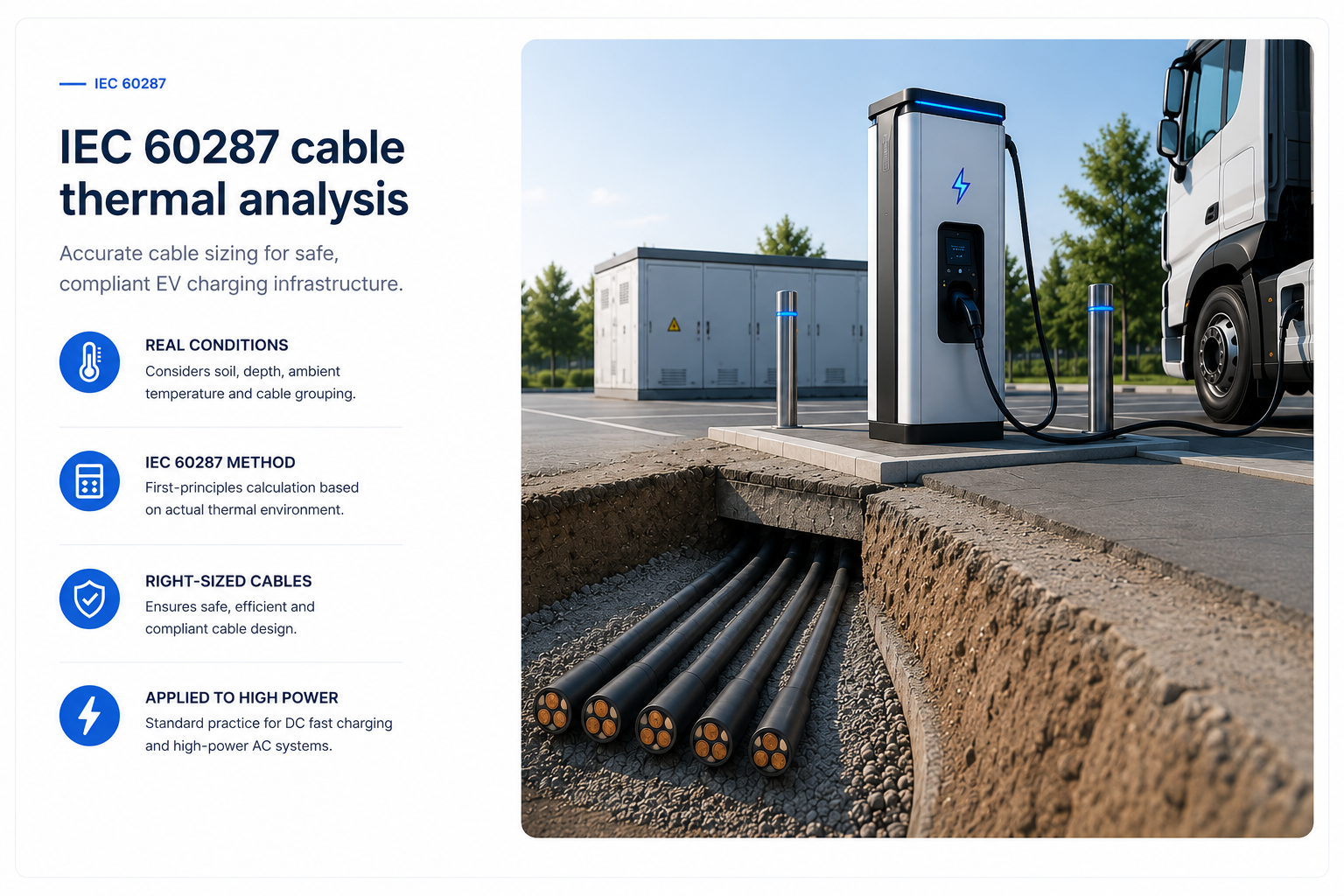
IEC 60287
Electric cables — calculation of the current rating
First-principles thermal modelling for specific installation conditions — soil resistivity, burial depth, grouping, ambient temperature, and load profile. Applied by EV Design to every DC and high-power AC cable system.
IEC 60287 cable thermal analysis — a capability most consultancies don't offer
Standard BS 7671 current-carrying capacity tables assume typical installation conditions. High-power DC EV charging is not typical — dense cable routes, variable soil thermal resistivity, and near-continuous loading mean the tables can understate the thermal risk significantly.
First-principles thermal modelling
We calculate the actual maximum current for your specific installation — burial depth, soil resistivity, grouping, duct arrangement, and load profile — not a generic table value.
Applied to every DC cable system
IEC 60287 analysis is standard practice on all our DC and high-power AC cable designs, not an optional extra. It is how confident cable sizing is done.
Prevents costly failures
Cables running above design temperature degrade, fail early, and in the worst case present a fire risk. Correct sizing from the outset eliminates this risk.
Complete electrical design capabilities
Every electrical engineering discipline needed to take an EV charging project from feasibility to construction — produced to a standard suitable for DNOs, building control, contractors and funders.
IEC 60287 Cable Thermal Analysis
Detailed cable thermal modelling in accordance with IEC 60287, confirming conductor sizing for the actual installation conditions — burial depth, soil thermal resistivity, grouping factors, and ambient temperature. This is the differentiating capability at the heart of EV Design's electrical work.
Electrical Load & Capacity Assessments
Analysis of the available electrical capacity at a site, including diversity assessment for multi-point charging installations, to establish what charging infrastructure can be supported without reinforcement — and what connection capacity will be needed to support future growth.
Cable Sizing & Routing Design
Full cable sizing calculations for AC and DC charging circuits, including selection of conductor cross-section, insulation rating and installation method, to ensure compliance with BS 7671 and the requirements of the charging equipment manufacturer.
Ducting & Containment Layouts
Design of the underground ducting and above-ground cable containment routes, coordinated with the civil works scope and the positions of the charging equipment. Includes duct sizing, draw-pit layouts and coordination with other buried services.
Earthing, Bonding & O-PEN Protection Design
Design of the earthing system for the EV charging installation, including selection of earthing arrangement (TN-S, TN-C-S or TT), earth electrode design where required, supplementary bonding, and Open Protective Earth Neutral (O-PEN) protection to BS 7671 and the IET Code of Practice for EV Charging Equipment Installation.
Protection, Fault-Level & Discrimination Studies
Fault-level calculations to establish the prospective short-circuit current at each point in the installation, and a protection discrimination study to confirm that the protective devices operate selectively — ensuring that only the faulted circuit is isolated, without unnecessary loss of supply elsewhere on site.
RCD Selection & Coordination
Selection of appropriate RCD types for EV charging circuits, including assessment of DC fault current injection by the charging equipment and specification of Type B or equivalent devices where required to prevent DC blinding — a particular concern for high-power DC and eHGV charging installations.
Equipment Compound & Feeder Pillar Layouts
Design of the electrical equipment compound — including switchgear, metering, distribution boards and feeder pillars — showing the physical arrangement, clearances, access requirements and cable entry arrangements, suitable for inclusion in the tender and construction package.
Tender Drawings, Specifications & Schedules
Production of the full tender documentation package: single-line diagrams, site layout and cable route drawings, installation drawings, cable schedules, equipment schedules and a detailed specification, in a format suitable for competitive tender or direct appointment of a contractor.
Construction-Stage Technical Support
Technical support during the construction phase, including responses to contractor queries, review of shop drawings and O&M submissions, site visits as required, and design changes to address conditions encountered during installation.
Design Reviews & Validation
Independent review and validation of electrical designs produced by others, assessing compliance with current standards, identifying design errors or omissions, and providing a written report suitable for use by the client, their project manager or a funder.
Technical Reports & Troubleshooting
Technical reports on specific aspects of an EV charging installation or an existing scheme with performance or compliance issues, including root cause analysis, recommendations for remediation, and supporting calculations.
Other services
Ready to start your EV charging project?
Talk to our specialists about feasibility, design and technical delivery — UK-wide.