
Electric HGV Charging Infrastructure Design
Specialist high-power charging design for electric heavy goods vehicles — covering the engineering depth that most general electrical consultancies do not provide.
eHGV charging presents engineering challenges beyond standard EV design
Electrifying heavy goods vehicle fleets is not simply a matter of scaling up standard EV charging infrastructure. The power levels involved, the earthing arrangements required, the protection considerations specific to DC charging equipment, and the complexity of interfacing with high-voltage distribution networks all create a set of engineering challenges that sit well outside the scope of everyday electrical installation design.
Many electrical consultancies active in the EV charging sector have extensive experience with AC charging and standard DC rapid chargers for cars. Far fewer have the knowledge to address the specific requirements of a multi-megawatt eHGV charging installation — particularly the earthing and RCD considerations that are essential to both compliance and safe operation.
EV Design has developed specific expertise in this area. We understand the standards that apply, the constraints imposed by the charging equipment, and the practical requirements of delivering a compliant installation that works reliably in a demanding operational environment.
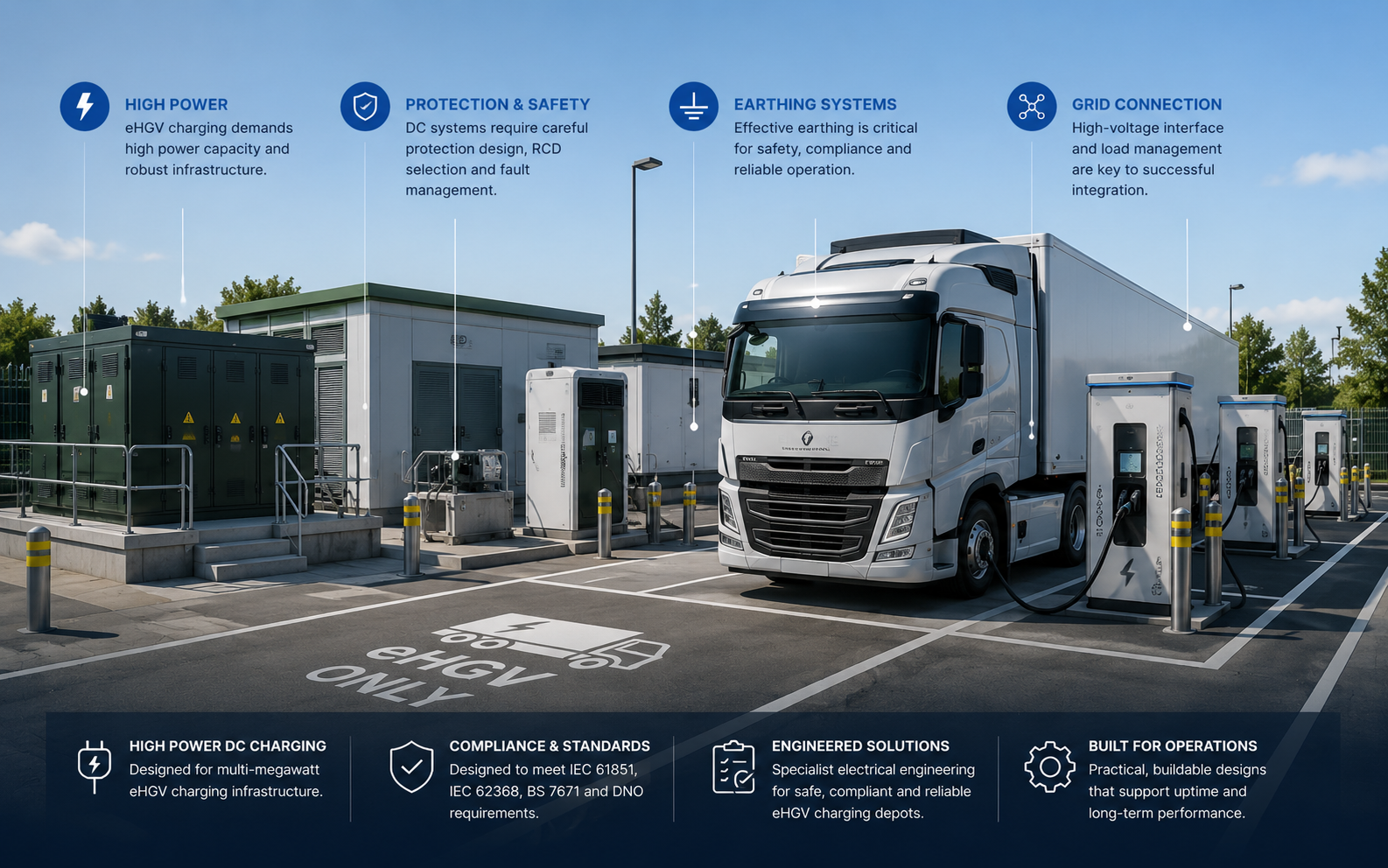
The engineering depth eHGV projects demand
High-Power DC Banks
eHGV charging installations typically require multiple high-power DC chargers operating simultaneously, creating concentrated electrical loads that demand careful diversity analysis, cable sizing for continuous full-load current, and a robust upstream protection and metering arrangement.
TT Earthing Systems
Many eHGV depot and en-route charging sites use TT earthing arrangements, particularly where the site has a dedicated HV supply or where the distribution network earthing is not accessible. Designing a compliant TT system with appropriate earth electrode resistance and RCD protection requires specialist knowledge of both the earthing standard and the characteristics of the charging equipment.
RCD Selection & DC Blinding
DC charging equipment can inject DC fault current components into the supply network, which can blind conventional AC RCDs — rendering them unable to respond to a fault condition. Correctly specifying Type B RCDs or equivalent DC fault current detection to prevent this blinding effect is a critical safety consideration that is frequently overlooked in general electrical design.
HV Substation Interface
The very high aggregate loads at eHGV hubs — often several megawatts — frequently require a dedicated HV substation, either owned by the site operator or provided by the DNO. Coordinating the HV/LV interface, agreeing protection settings, and designing the LV busbar arrangement requires close collaboration with the DNO and careful engineering at the LV design stage.
Feeder Pillar & Equipment Compound Layouts
eHGV installations require robust, accessible electrical infrastructure — feeder pillars, metering panels, distribution boards and cable management — all laid out to accommodate large vehicles manoeuvring on site. The physical layout of the electrical infrastructure must be integrated with the site layout from the earliest design stage.
DNO & Utility Coordination
Securing grid capacity for a multi-megawatt eHGV hub requires early and sustained engagement with the Distribution Network Operator. EV Design supports clients through the connection application process, including providing the technical information required by DNOs and coordinating with network planners to secure the necessary capacity in a realistic timescale.
Complete eHGV charging design package
Our eHGV charging design service covers the full electrical engineering scope — from initial feasibility and grid capacity assessment through to construction-ready drawings, specifications and schedules.
- eHGV charging feasibility and capacity study
- High-power DC site layout drawings
- Electrical load and diversity analysis
- TT earthing system design and electrode specification
- RCD selection report (DC blinding assessment)
- IEC 60287 cable thermal analysis report
- Cable sizing and routing calculations
- Protection, fault-level and discrimination study
- Feeder pillar and equipment compound layouts
- HV substation interface coordination
- DNO connection application support
- Ducting and containment drawings
- Lighting and associated site electrical design
- Tender drawings, specifications and schedules
- Construction-stage technical support
Logistics & Distribution
- Distribution centre charging depots
- Supermarket and retail logistics
- Parcel and courier fleet depots
- Cold chain and temperature-controlled
Haulage & Transport
- Long-haul truck depots
- Short-haul and regional hauliers
- Container port and rail freight
- Intermodal logistics hubs
Public & Municipal
- Local authority refuse and utilities
- Emergency services fleets
- Public transport bus depots
- Street cleansing and gritting fleets
En-Route Infrastructure
- Motorway service area eHGV bays
- Truck stops and rest areas
- Border and customs facilities
- Port electrification schemes
Other services
Ready to start your EV charging project?
Talk to our specialists about feasibility, design and technical delivery — UK-wide.